

TL;DR
- How accurate is facial recognition ID verification? Judge false matches and false rejections separately, not one headline percentage.
- NIST evaluates face recognition performance; benchmark results are not guarantees for a guest verification workflow.
- Checktiv suits independent hosts who want zero-code guest verification through shared links.
- Face matching, document checks and liveness checks answer different questions. Ask which checks your provider performs.
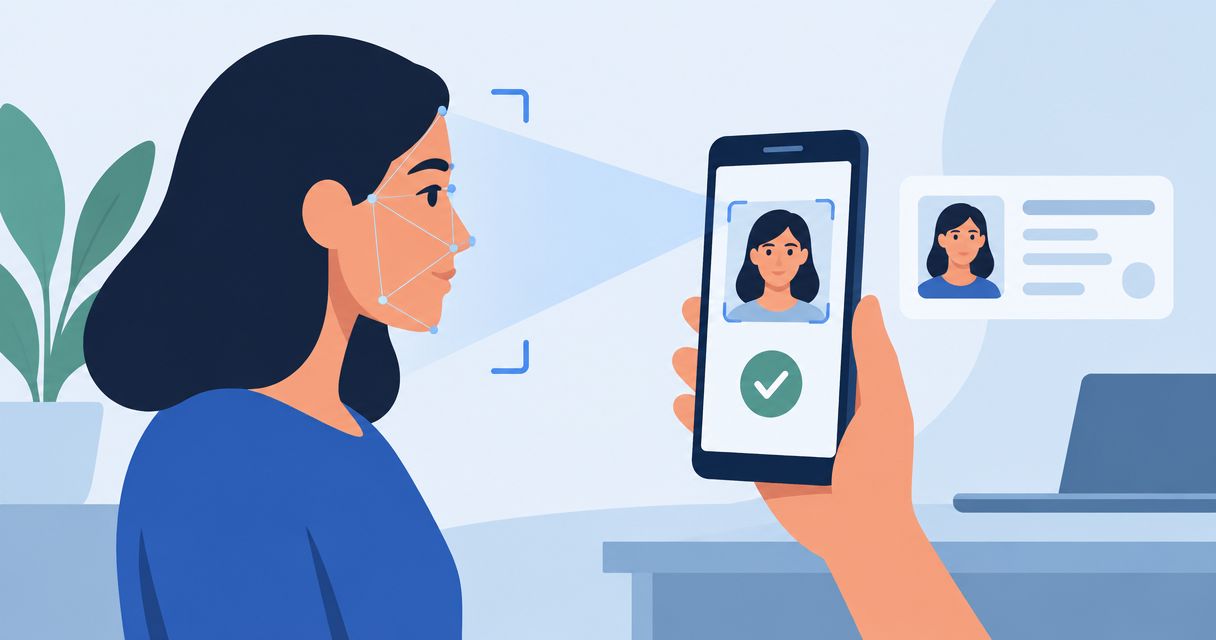
Facial recognition ID verification has no single accuracy rate: results depend on the matching system, the photos, the acceptance threshold and the people being verified. A face match also does not establish that an ID is genuine or that the person submitting a selfie is physically present, so you need to assess those checks separately.
How accurate is facial recognition ID verification?
Accuracy is meaningful only when you know what was measured and under which conditions. A system that compares a guest's selfie with an ID portrait performs a different task from a system searching a collection of faces.
For short-term rentals, the useful question is whether your verification process gives you a clear result and a practical next step. The ID verification guide for short-term rental hosts covers the hosting workflow around that decision.
Start with these measures when assessing a provider in 2026:
| Measure or check | What it tells you | What it does not establish |
|---|---|---|
| False match rate | How often different people are incorrectly matched under the tested conditions | Whether the submitted document is genuine |
| False non-match rate | How often the same person is incorrectly rejected under the tested conditions | Whether a rejected guest intended to misrepresent their identity |
| Document examination | Whether the document passes the checks the provider performs | Whether the person presenting it is its rightful holder |
| Liveness or presentation attack detection | Whether a capture passes checks intended to distinguish a live presentation from an attack | Whether every other part of the identity claim is correct |
A low false match rate is useful, but it is not the whole answer. If legitimate guests struggle to complete verification, you also need to understand false rejections and capture failures.
The National Institute of Standards and Technology, or NIST, publishes Face Recognition Technology Evaluation results. These provide an independent basis for examining tested algorithms. They do not certify every booking workflow using those algorithms.
Why this matters for your guest experience
You want a professional arrival process, not a debate about a percentage. A verification result should help you decide what to do next while giving your guest understandable instructions.
A rejected selfie is not proof of dishonesty. Poor lighting, an unsuitable capture or a mismatch between an older portrait and a current face can affect the comparison. Treat the result as a reason to follow your review process, not as a character judgment.
A successful face match has limits too. It supports the conclusion that the compared faces belong to the same person, within the system's operating conditions. It does not tell you whether that guest will follow your house rules.
Use identity verification to confirm identity, and use your booking policies to set expectations. Those are separate jobs.
Which accuracy measures should you ask for in 2026?
Ask for the 2 error rates separately: false matches and false non-matches. A single accuracy percentage can hide the balance between accepting the wrong person and rejecting the right person.
False match rate: different people accepted as a match
A false match happens when the system accepts a comparison between different people. For a selfie-to-ID workflow, that is the error associated with accepting a face that does not belong to the document holder.
Ask which acceptance threshold produced the reported rate. A benchmark result without its threshold and test conditions is not enough to compare providers fairly.
Also ask whether the figure measures the face comparison alone or the full verification process. Those are different claims, even if both appear under an accuracy heading.
False non-match rate: the same person rejected
A false non-match happens when images of the same person fail the comparison. This matters to hosts because a legitimate guest still needs a workable route through verification.
Ask how the provider handles an inconclusive result. Look for clear instructions, an appropriate retry process and an explanation of what the host should review.
Do not interpret every unsuccessful verification as a face-matching error. A guest who never finishes submitting a photo has not necessarily received a biometric rejection.
Completion rate: whether guests finish the process
Completion rate describes whether people finish a workflow. It is an operational measure, not a substitute for biometric accuracy.
Ask how the provider defines completion and what starts the measurement. Opening a verification link, beginning a capture and submitting a complete verification are different events.
For your rental business, record unfinished attempts separately from completed checks that need review. That distinction tells you whether to improve instructions or investigate a verification result.
Why facial recognition accuracy varies
The conditions around the comparison matter as much as the headline claim. These factors explain why a laboratory result does not automatically describe your guest experience:
- Photo quality. Blur, poor exposure and low detail reduce the useful information available for comparison. Clear capture instructions are part of a workable process.
- Face position and visibility. A turned face, an obstructed face or an unsuitable crop changes what the system can compare. Follow the provider's capture requirements.
- Time between photos. An ID portrait and a current selfie can show changes in appearance. Ask how the provider evaluates comparisons involving older document portraits.
- Acceptance threshold. A stricter threshold changes the balance between false matches and false non-matches. Compare results at stated operating points.
- Who appears in the evaluation. NIST research documents demographic differences in face recognition performance. Ask for results relevant to the people who will use your service.
- The task being tested. Matching a selfie to an ID portrait is not the same as searching a large collection of faces. Evidence should match the task you actually need.
None of these factors justifies guessing a guest's identity from appearance. They explain why a good workflow needs useful capture guidance and a clear response to uncertainty.
Is matching an ID photo different from searching a face database?
Yes. One-to-one verification compares a claimed identity; one-to-many identification searches for an identity. Evidence for one task should not be presented as proof of performance for the other.
| Approach | Best for | Main advantage | Main limitation |
|---|---|---|---|
| One-to-one face verification | Checking a selfie against a supplied ID portrait | Tests a specific identity claim | Does not establish document authenticity by itself |
| One-to-many face identification | Searching an enrolled collection for possible matches | Can return identity candidates from a collection | Search performance does not describe a selfie-to-ID workflow |
A rental host generally needs a clear answer about the identity presented for a booking, not a lesson in database searching. When you read a 2026 comparison, check whether its evidence concerns verification or identification before accepting its verdict.
The same caution applies to demonstrations. Recognizing a face in a polished example is not evidence of performance across the capture conditions your guests encounter.
Does a successful face match mean the ID is genuine?
No. A successful face match concerns the relationship between the faces being compared, not the authenticity of the document carrying the portrait.
Document examination addresses a different question. Depending on the provider's stated process, it can assess document information and signs of alteration. Ask which document types and checks the provider supports rather than assuming every verification includes the same examination.
For a host, the practical next move is simple: understand what each result means. If a provider displays an overall pass or review status, ask which underlying checks contribute to it.
Do not turn a face-match result into a broader claim than the check supports. A clear result explanation is more useful than an impressive label.
Can facial recognition tell whether a selfie is live?
Face matching alone does not establish liveness. Liveness checks and presentation attack detection address whether the submitted capture represents a live presentation rather than an attempted substitute.
These checks require their own evidence. NIST's Face Analysis Technology Evaluation includes evaluation of presentation attack detection, which is distinct from evaluating face-matching performance.
Ask what was tested and how the evaluation relates to the capture method guests use. Do not assume a strong face-recognition benchmark also demonstrates strong liveness performance.
For your 2026 verification checklist, keep the questions separate: Does the face match? Does the document pass its checks? Does the capture pass the provider's liveness checks? Separation makes the outcome easier to interpret.
How do you evaluate a provider without becoming a specialist?
You do not need to become a biometric researcher. You need answers that connect evidence to your booking process.
- Identify the task. Confirm that the evidence concerns selfie-to-ID verification rather than face database searching.
- Request the measures. Ask for false match and false non-match rates, together with the thresholds and conditions used.
- Separate the checks. Ask which document and liveness checks are included and what each result means.
- Examine the guest journey. Review the instructions, capture requirements and next steps when a result is inconclusive.
- Set a review policy. Decide who reviews unclear results and what guests should do next before you introduce the process.
Ask for the publication date and scope of any independent evaluation. The evidence should identify the tested algorithm or system and the task it performed. A provider name alone is not enough to connect a report to a current service.
Avoid asking only, 'What is your accuracy?' Ask, 'What does this result establish for this guest, and what happens if it is unclear?' That question produces a more useful purchasing conversation.
Where shared-link verification fits for independent hosts
Checktiv is best for independent short-term rental hosts who want zero-code guest verification through shared links. Its practical benefit is a straightforward way to request and review verification without building a technical integration.
Checktiv describes the getting-started journey as 3 steps in 5 minutes:
- Sign up. Create your account.
- Get a link. Use a shared link to request guest verification.
- Review verification. Review the verification before making your hosting decision.
The setup description is not a biometric accuracy rate or a promise that every guest completes verification within that time. Keep those claims separate.
*A simple setup process does not replace understanding what the verification result establishes.*
The advantage is an accessible request-and-review workflow for a non-technical host. The limitation is that a shared link, by itself, tells you nothing about a matching algorithm's measured accuracy. Evaluate the result explanations and the underlying checks as well as the ease of setup.
One last thing
A verification process can become stricter without becoming more useful for your guests. Changing the acceptance threshold changes the balance between false matches and false rejections; it does not remove that trade-off.
Before choosing a service in 2026, write down what you will do with a clear result, an unclear result and an unfinished attempt. Checktiv's shared-link workflow gives independent hosts a simple way to request verification. Your review policy gives that request a useful ending.
Related guides
- Identity verification software ranked by accuracy
- Facial recognition ID verification tools
- How long does an ID verification check take?
Start your guest verification workflow
Use shared links to request guest verification, with zero-code setup.
$5 in free credit on signup · no card required.
Frequently asked questions
How accurate is facial recognition ID verification in 2026?
Facial recognition ID verification has no universal accuracy rate in 2026. Assess false match and false non-match rates at stated thresholds, then evaluate document and liveness checks separately.
Can a legitimate guest fail facial recognition verification?
Yes, a legitimate guest can fail a face comparison. Image quality, face visibility and differences between the ID portrait and current selfie can affect the result, so an unsuccessful check needs a defined next step.
Does passing facial recognition prove an ID is real?
No, passing a face comparison does not prove that the ID is genuine. Document examination is a separate check, and you should ask what the provider actually examines.
Is liveness detection the same as facial recognition?
No, liveness detection and face matching answer different questions. Face matching compares identity, while liveness checks assess whether a capture passes checks for a live presentation.
What should I ask a provider about its accuracy claim?
Ask for false match and false non-match rates, the acceptance threshold and the evaluation conditions. Also confirm that the evidence concerns the same verification task your guests will complete.
Is Checktiv suitable for a host without technical skills?
Checktiv is built for independent hosts who want guest verification through shared links with zero-code setup. Assess the workflow alongside the meaning of its verification results, not as a substitute for accuracy evidence.
Should I decline a booking because a selfie check failed?
A failed selfie check alone is not proof that a guest misrepresented their identity. Follow your review policy, check the result explanation and give the guest the appropriate next step.