

TL;DR
- How does liveness detection prevent spoofing? It checks for live presence, not just a recognizable face.
- Active liveness requests an action; passive liveness assesses the capture without a prompted gesture.
- A successful liveness check does not prove an identity document is genuine or a booking is appropriate.
- Checktiv guest verification suits independent hosts who want a zero-code, shared-link workflow.
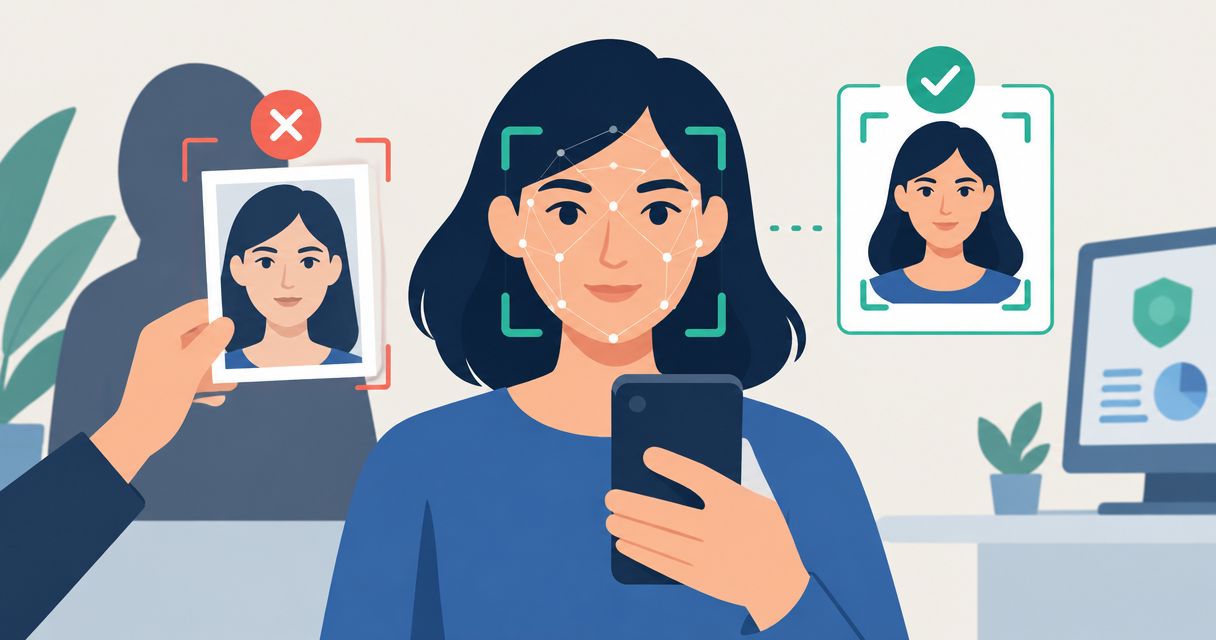
Liveness detection prevents spoofing by checking whether a face capture comes from a live person rather than a printed photo, a replayed video, or another presentation attack. It adds evidence that someone is physically present, but identity verification still needs separate checks for document authenticity, face matching, and attempts to substitute the camera feed.
How does liveness detection prevent spoofing in ID verification?
Liveness detection looks for evidence that a face presented during verification belongs to a live person at capture time. A face match answers a different question: whether that face resembles the photograph associated with the claimed identity.
Recognizing a face is not the same as establishing live presence. A photograph can resemble an ID portrait without establishing that the person pictured is participating in the check.
The distinction also explains why document verification checks for forged IDs remain necessary. Liveness examines the face presentation, not the authenticity of the identity document.
| Check | What it establishes | Best for | Main limitation |
|---|---|---|---|
| Document verification | Evidence that an identity document is authentic | Assessing the submitted ID | Does not establish live presence |
| Face matching | Similarity between a captured face and an ID portrait | Connecting a participant to a document | Similarity alone does not detect every spoof |
| Liveness detection | Evidence of a live person during capture | Detecting presentation attacks | Does not validate the document or booking |
| Capture integrity checks | Evidence that the capture process has not been substituted or manipulated | Addressing injected or altered camera input | Coverage depends on the implementation |
These checks support one another. None should be treated as a substitute for all the others, and a successful result from one check should not silently override an unresolved result elsewhere.
Why this matters
For a short-term rental host, the practical goal is a clear verification decision without turning arrival preparation into a technical project. You need to understand what a result establishes before using it to move a reservation forward.
A guest who passes a liveness check has supplied evidence of live presence. That result does not establish that the guest owns the payment card, will follow house rules, or has permission to book for someone else.
For your 2026 verification process, keep those decisions separate. Use liveness to support identity verification, not to predict guest behavior. A narrow, accurate interpretation gives you more control than a broad promise of a completely verified booking.
Active liveness: best for prompted participation
Active liveness asks the person to perform an action during capture. Depending on the implementation, that action can involve turning the head, following an on-screen instruction, or completing another challenge.
The system assesses whether the response fits the challenge. A fixed photograph cannot naturally respond to a newly requested movement, which makes prompted participation useful against straightforward presentation attacks.
The benefit is a visible interaction between the participant and the verification session. The trade-off is an extra instruction that the guest must understand and complete.
Accessibility matters here. A challenge that depends on a particular movement needs an appropriate alternative for people who cannot perform it, and unclear instructions should not become an unexplained rejection.
Choose active liveness when the prompted interaction fits your guests and the service provides a clear recovery path. Do not assume that asking someone to blink is, by itself, sufficient evidence of effective spoof detection.
Passive liveness: best for fewer prompted actions
Passive liveness assesses the face capture without asking the person to complete a specific gesture. Depending on the system, it can evaluate image characteristics, changes across frames, depth information, or other evidence available during capture.
The guest-facing advantage is fewer instructions. A capture can feel more like taking a selfie than completing a movement challenge.
The limitation is visibility into the decision. A simple experience does not tell you which attacks the underlying system was designed or tested to detect.
Choose passive liveness when fewer guest actions matter, then verify the evidence behind the detection claim. A short capture process is an experience benefit, not an accuracy measurement.
| Approach | Best for | Guest action | Advantage | Trade-off |
|---|---|---|---|---|
| Active liveness | Workflows suited to explicit challenges | Follows a requested action | Connects a response to a challenge | Adds instructions and accessibility considerations |
| Passive liveness | Workflows prioritizing fewer prompted actions | Completes the requested capture | Reduces gesture-based interaction | Detection coverage is not apparent from the interface |
Neither label establishes that a service is better. For a 2026 evaluation, compare the attacks covered, the capture conditions tested, and the experience when a legitimate guest needs another attempt.
What happens during a liveness check?
The exact sequence varies by service, but the underlying decisions should remain distinct. Ask the provider to explain where live presence is assessed and how that result connects to the rest of identity verification.
- Capture. The guest supplies the requested face image or video through the verification experience. Clear instructions help the guest provide usable input.
- Assess liveness. The service evaluates evidence of live presence and signs of a presentation attack. A challenge response belongs here when active liveness is used.
- Match identity. The service compares the captured face with the relevant identity portrait. This is separate from deciding whether the capture represents a live person.
- Review results. The verification outcome supports your decision. An incomplete capture, an identity mismatch, and suspected spoofing should not be treated as interchangeable explanations.
*Live presence and identity matching answer different questions.*
The host does not need to interpret raw image signals. The useful operational detail is whether the result supports approval, requires a fresh capture, or needs further review under your established process.
Why liveness detection results vary
Liveness detection is not a single universal test. Its performance depends on what the service examines, the capture environment, and the attacks included in its evaluation.
- Attack coverage. Detecting printed photographs does not establish equivalent performance against video replays, masks, or altered camera input.
- Capture conditions. Lighting, blur, framing, and camera characteristics affect the evidence available for assessment.
- Challenge design. Active checks depend on how the requested action is generated and how the response is evaluated.
- Decision thresholds. A stricter threshold changes the balance between accepting attacks and interrupting genuine participants.
- Capture integrity. Checking the face presentation and protecting the capture channel address different parts of the verification process.
- Evaluation scope. A result from a defined test applies to that test's conditions and attack set, not every possible verification session.
For your 2026 shortlist, ask for the scope behind each performance claim. A percentage without an attack definition, test conditions, and an explanation of genuine-user failures is not enough to compare services.
Can liveness detection stop deepfakes and injected video?
Liveness detection can identify signs of some synthetic or manipulated presentations, but it does not guarantee that every deepfake will be rejected. A replay shown to a camera and a fabricated feed substituted for the camera are different attack paths.
Presentation attack detection examines what is presented to the capture device. Capture integrity measures address whether the input itself has been replaced or manipulated before assessment.
That distinction belongs in a purchasing conversation. Ask whether the provider evaluates camera-facing attacks, injected inputs, or both, and whether the supporting tests distinguish those categories.
Do not accept “deepfake protection” as a complete technical explanation. Ask what was tested and where protection operates. A specific answer is more useful than a broad claim that all synthetic faces are blocked.
What should you ask a verification provider in 2026?
Start with the decision you need to make, not the longest feature list. For a host, that means understanding the guest experience, the result you receive, and what happens when a genuine guest cannot complete the check.
Comparing identity verification software requires separating document checks, face matching, liveness, and capture integrity because evidence for one does not establish the others. Evaluate those functions individually before treating them as a complete verification process.
Use these questions to keep the discussion concrete:
- Which attacks are covered? Request a distinction between photographs, screen replays, masks, and substituted camera input.
- What evidence supports the claim? Ask for the test scope, conditions, and the relevance of any independent assessment.
- What does the guest do? Understand the capture instructions, device requirements, and any prompted actions.
- What happens after an unsuccessful attempt? Confirm how the guest retries and what information reaches you.
- How is biometric information handled? Ask about collection, retention, deletion, access, and the applicable privacy responsibilities.
You do not need to become a biometric specialist. You need answers that distinguish proven coverage from product language and a workflow your guests can complete without unnecessary confusion.
How should you handle a guest who cannot complete the check?
An unsuccessful liveness attempt is not, by itself, proof of attempted spoofing. Poor capture quality, device limitations, accessibility needs, and suspected presentation attacks require different responses.
Give the guest clear instructions for the next permitted step. If the service identifies a capture-quality problem, a fresh capture under better conditions is different from bypassing a substantive verification concern.
Keep the explanation neutral: the verification needs another attempt or further review. Do not accuse a guest of deception based only on an incomplete session.
Your process should also define who can make exceptions and what evidence is required. Avoid improvising a weaker identity check in a message thread simply because arrival is approaching. A consistent recovery process supports both hospitality and operator control.
Where Checktiv guest verification fits
Checktiv gives independent short-term rental hosts a shared-link verification experience with zero-code setup. The stated setup journey is 3 steps in 5 minutes: sign up, get a link, and review the verification.
Checktiv guest verification is best for independent hosts who want a professional shared-link workflow with 0 lines of code required. That is the operational fit: you can organize verification around a link rather than building a custom guest-facing process.
The boundary is equally important. A convenient verification workflow does not turn identity evidence into a guarantee about a stay, a payment dispute, or future guest conduct.
For your 2026 hosting process, decide when you will send the link and who will review the outcome. Keep the request consistent across comparable bookings, and explain what the guest needs to do before sending arrival instructions.
Is liveness detection the same as facial recognition?
Liveness detection assesses live presence; facial recognition assesses identity or similarity. A face-matching step can compare a selfie with an ID portrait without establishing that the selfie came from a live participant.
For remote identity verification, treat these as complementary checks. Neither result should be relabeled as proof of everything the other check is designed to establish.
Does passing liveness mean a guest is fully verified?
Passing liveness means the capture met the service's criteria for live presence. It does not establish that the submitted document is authentic or that the participant matches the document holder.
A booking decision can also involve information outside identity verification. Keep payment questions, reservation details, and house-rule acceptance separate from the biometric result.
One last thing
A live person can still present someone else's genuine ID. That is why a liveness pass should never replace face matching or document verification.
Before your next booking review, write down what each result establishes. If your process cannot distinguish “live participant,” “matching face,” and “authentic document,” improve the decision checklist before adding another verification requirement for guests.
Related guides
- Can identity verification stop chargeback fraud?
- ID verification for short-term rental hosts
- Can guest screening prevent property damage claims?
Simplify your guest verification
Use a shared-link workflow with zero-code setup for independent hosts.
$5 in free credit on signup · no card required.
Frequently asked questions
How does liveness detection prevent spoofing?
Liveness detection prevents spoofing by assessing whether a face capture represents a live person rather than a photograph, replay, or other presentation attack. Its effectiveness depends on the attacks covered and the capture conditions.
Can someone pass a liveness check with a photograph?
Liveness detection is designed to identify presentation attacks such as photographs, but no universal guarantee applies to every service. Ask for evidence covering the specific attack types you need addressed.
Is passive liveness better than active liveness?
Passive liveness is better suited to fewer prompted actions, while active liveness uses an explicit challenge. Neither approach is inherently better across every attack type, guest population, and capture environment.
Does a blinking test stop deepfakes?
A blinking test alone does not establish protection against deepfakes. Effective evaluation must consider how the challenge is generated, how the response is assessed, and whether the capture input can be substituted.
Why would a genuine guest fail a liveness check?
A genuine guest can have an unsuccessful attempt because of capture quality, device limitations, or difficulty completing instructions. An unsuccessful attempt should not automatically be treated as evidence of deception.
Does liveness detection verify an identity document?
Liveness detection does not verify an identity document. Document authenticity checks and face matching provide separate evidence needed to connect a live participant to a claimed identity.
Do hosts need to write code to use Checktiv?
Hosts do not need to write code to use Checktiv's shared-link guest verification workflow. The setup journey is sign up, get a link, and review the verification.